





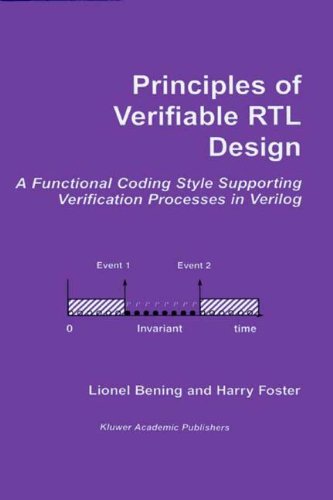
Principles of Verifiable RTL Design - A Functional Coding Style Supporting Verification Processes
Principles of Verifiable RTL Design: A Functional Coding Style Supporting Verification Processes in Verilog explains how you can write Verilog to describe chip designs at the RT-level in a manner that cooperates with verification processes. This cooperation can return an order of magnitude improvement in performance and capacity from tools such as simulation and equivalence checkers. It reduces the labor costs of coverage and formal model checking by facilitating communication between...

FPGA Simulation: A Complete Step-by-Step Guide
FPGA Simulation: A Complete Step-by-Step Guide shows FPGA design engineers how to avoid long lab debug sessions by simulating with SystemVerilog. The book helps engineers to have never simulated their designs before by bringing them through seven steps that can be added incrementally to a design flow. Engineers start with code coverage as the first step. Succeeding steps introduce test planning, assertions, and SystemVerilog simuation techniques. By the end of the process engineers who...

Digital Integrated Circuit Design Using Verilog and Systemverilog
For those with a basic understanding of digital design, this book teaches the essential skills to design digital integrated circuits using Verilog and the relevant extensions of SystemVerilog. In addition to covering the syntax of Verilog and SystemVerilog, the author provides an appreciation of design challenges and solutions for producing working circuits. The book covers not only the syntax and limitations of HDL coding, but deals extensively with design problems such as partitioning and...

SuperSpeed Device Design By Example
This is a "How-To" book which explains, with hands-on examples, how to design and implement a SuperSpeed USB peripheral that can interface to your hardware using a 32-bit 100MHz bus with standard or custom protocols. The book is based on the Cypress FX3 SuperSpeed Device and the firmware examples are written around a low-cost SuperSpeed Explorer board and a companion CPLD board which are available from www.cypress.com/fx3book. The software examples are written for the Windows operating...

The Art of Verification with SystemVerilog Assertions
The Art of Verification with SystemVerilog Assertions (SVA) covers all aspects of SVA with numerous, detailed examples. The book demonstrates how SVA can be harnessed to implement effective, assertion-based verification.
It teaches the SVA language by explaining its usage in the context of practical verification issues. SVA syntax and features are explained in simple and easy-to-understand language. The usage of each construct is illustrated with both simple examples and examples drawn from...

Verilog Digital System Design
Hardware description languages are used to design high density VLSI, allowing designers to put millions of transistors on a single substrate. Verilog is closing in on VHDL as the most popular of the hardware description languages. This is a tutorial in designing with Verilog. Each major chapter features in-depth Verilog examples of the coding described, and all the examples are assembled into a final full CPU design. The CD-ROM includes a Verilog simulator and all examples worked in the book.

Hdl Chip Design: A Practical Guide for Designing, Synthesizing & Simulating Asics & Fpgas Using Vhdl or Verilog
100% Satisfaction is Guaranteed! There are no problems in page content and in the paper. There are no problems except minor faults. For New condition books in our store; You will be the first user. You will be the first to open the book cover. For Used condition books in our store; It shows signs of wear from consistent use, but it remains in good condition and works perfectly. All pages and cover are intact , but may have aesthetic issues such as price clipping, nicks, scratches, and...

Introduction to Verilog
This self-study guide came about as the result of the popularity of my textbook, Verilog Designer's Library. That book is an intermediate to advanced level reference book about the Verilog Hardware Description Language. Shortly after its publication, the Institute of Electrical and Electronics Engineers (IEEE) approached me to create an introductory book, based on the Verilog seminar that I give around the world. Over the years I've used the feedback from students to try to make it the best...

Digital System Designs and Practices: Using Verilog HDL and FPGAs
System-on-a-chip (SoC) has become an essential technique to lower product costs and maximize power efficiency, particularly as the mobility and size requirements of electronics continues to grow. It has therefore become increasingly important for electrical engineers to develop a strong understanding of the key stages of hardware description language (HDL) design flow based on cell-based libraries or field-programmable gate array (FPGA) devices. Honed and revised through years of classroom...

Design Through Verilog HDL
A comprehensive resource on Verilog HDL for beginners and experts
Large and complicated digital circuits can be incorporated into hardware by using Verilog, a hardware description language (HDL). A designer aspiring to master this versatile language must first become familiar with its constructs, practice their use in real applications, and apply them in combinations in order to be successful. Design Through Verilog HDL affords novices the opportunity to perform all of these tasks, while...

Starter's Guide to Verilog 2001
Introducing the Verilog HDL in a brief format, this book presents a selected set of the changes the popular hardware underwent in its first revision—emerging as IEEE Std 1364-2001 or Verilog-2001. It addresses the main features that support the design of combinational and sequential logic, and emphasizes synthesizable models, with a limited discussion of the theoretical framework for synthesis. Chapter topics cover an Introduction to Digital Design Methodology; Basic Concepts:...

Writing Testbenches: Functional Verification of HDL Models
mental improvements during the same period. What is clearly needed in verification techniques and technology is the equivalent of a synthesis productivity breakthrough. In the second edition of Writing Testbenches, Bergeron raises the verification level of abstraction by introducing coverage-driven constrained-random transaction-level self-checking testbenches all made possible through the introduction of hardware verification languages (HVLs), such as e from Verisity and OpenVera from...

Verilog HDL: A Guide to Digital Design and Synthesis
Appropriate for all courses in digital IC or system design using the Verilog Hardware Description Language (HDL). Fully updated for the latest versions of Verilog HDL, this complete reference progresses logically from the most fundamental Verilog concepts to today's most advanced digital design techniques. Written for both experienced students and newcomers, it offers broad coverage of Verilog HDL from a practical design perspective. One step at a time, Samir Palnitkar introduces students...

Verilog Hdl: A Guide to Digital Design and Synthesis
Verilog HDL is a language for digital design, just as C is a language for programming. This complete Verilog HDL reference progresses from the basic Verilog concepts to the most advanced concepts in digital design. Palnitkar covers the gamut of Verilog HDL fundamentals, such as gate, RTL, and behavioral modeling, all the way to advanced concepts, such as timing simulation, switch level modeling, PLI, and logic synthesis. Verilog HDL is a hardware description language (with a user community...

Advanced Digital Design with the Verilog(TM) HDL
Aimed at advanced courses in digital design for seniors and first-year graduate students in electrical engineering, computer engineering, and computer science, this book assumes and builds on the background of a first course in logic design.
Principles of Verifiable RTL Design: A functional coding style supporting verification processes in Verilog
System designers, computer scientists and engineers have c- tinuously invented and employed notations for modeling, speci- ing, simulating, documenting, communicating, teaching, verifying and controlling the designs of digital systems. Initially these s- tems were represented via electronic and fabrication details. F- lowing C. E. Shannon’s revelation of 1948, logic diagrams and Boolean equations were used to represent digital systems in a fa- ion that de-emphasized electronic and...
Principles of Verifiable RTL Design - A Functional Coding Style Supporting Verification Processes
Principles of Verifiable RTL Design: A Functional Coding Style Supporting Verification Processes in Verilog explains how you can write Verilog to describe chip designs at the RT-level in a manner that cooperates with verification processes. This cooperation can return an order of magnitude improvement in performance and capacity from tools such as simulation and equivalence checkers. It reduces the labor costs of coverage and formal model checking by facilitating communication between...
Introduction to Verilog
This self-study guide came about as the result of the popularity of my textbook, Verilog Designer's Library. That book is an intermediate to advanced level reference book about the Verilog Hardware Description Language. Shortly after its publication, the Institute of Electrical and Electronics Engineers (IEEE) approached me to create an introductory book, based on the Verilog seminar that I give around the world. Over the years I've used the feedback from students to try to make it the best...

Verilog Styles for Synthesis of Digital Systems
This book is designed specifically to make the cutting-edge techniques of digital hardware design more accessible to those just entering the field. The text uses a simpler language (Verilog) and standardizes the methodology to the point where even novices can get medium complex designs through to gate-level simulation in a short period of time. Requires a working knowledge of computer organization, Unix, and X windows. Some knowledge of a programming language such as C or Java is...

Modeling, Synthesis, and Rapid Prototyping with the VERILOG (TM) HDL
Verilog aims to introduce new users to the language of Verilog with instruction on how to write hardware descriptions in Verilog in a style that can be synthesized by readily available synthesis tools. Offers clear exposition of the Verilog hardware description language. This book is written in a style that allows the user who has no previous background with hardware description languages (HDLs) to become skillful with the language. Features treatment of synthesis-friendly...