




Computer Arithmetic: Algorithms and Hardware Designs (The ^AOxford Series in Electrical and Computer Engineering)
Ideal for graduate and senior undergraduate courses in computer arithmetic and advanced digital design, Computer Arithmetic: Algorithms and Hardware Designs, Second Edition, provides a balanced, comprehensive treatment of computer arithmetic. It covers topics in arithmetic unit design and circuit implementation that complement the architectural and algorithmic speedup techniques used in high-performance computer architecture and parallel processing. Using a unified and consistent framework,...

Embedded Core Design with FPGAs
This is a complete toolkit for designing embedded cores and utilizing those cores in an embedded system. A landmark guide in digital system design, "Embedded Core Design with FPGAs" equips today's computer engineers with everything they need to design embedded cores and apply those cores in a state-of-the-art embedded system. This practical resource brings together logic design, computer architecture, Verilog, FPGAs, Hardware/Software design, and SoCs, explaining how engineers can draw on...

Digital Systems Design with FPGAs and CPLDs
This textbook explains how to design and develop digital electronic systems using programmable logic devices (PLDs). Totally practical in nature, the book features numerous (quantify when known) case study designs using a variety of Field Programmable Gate Array (FPGA) and Complex Programmable Logic Devices (CPLD), for a range of applications from control and instrumentation to semiconductor automatic test equipment.Key features include:* Case studies that provide a walk through of the...

Vhdl for Logic Synthesis
VHDL for Logic Synthesis Second Edition Andrew Rushton TransEDA Limited, Southampton, UK Very high-speed integrated circuit Hardware Description Language (VHDL) is the worldwide standard for computer-aided electronic system design. Logic synthesis automates gate-level design, allowing the designer to concentrate on a rgister-transfer level implementation. VHDL for Logic Synthesis provides comprehensive coverage of the language and its role in the generation of hardware. This enhanced second...

Digital Systems Design Using VHDL
Written for an advanced-level course in digital systems design, DIGITAL SYSTEMS DESIGN USING VHDL integrates the use of the industry-standard hardware description language VHDL into the digital design process. Following a review of basic concepts of logic design, the author introduces the basics of VHDL, and then incorporates more coverage of advanced VHDL topics. Rather than simply teach VHDL as a programming language, this book emphasizes the practical use of VHDL in the digital design...

The Verilog® Hardware Description Language
XV From the Old to the New xvii Acknowledgments xx| Verilog A Tutorial Introduction Getting Started 2 A Structural Description 2 Simulating the binaryToESeg Driver 4 Creating Ports For the Module 7 Creating a Testbench For a Module 8 Behavioral Modeling of Combinational Circuits 11 Procedural Models 12 Rules for Synthesizing Combinational Circuits 13 Procedural Modeling of Clocked Sequential Circuits 14 Modeling Finite State Machines 15 Rules for Synthesizing Sequential Systems 18...

Modeling, Synthesis, and Rapid Prototyping with the VERILOG (TM) HDL
Verilog aims to introduce new users to the language of Verilog with instruction on how to write hardware descriptions in Verilog in a style that can be synthesized by readily available synthesis tools. Offers clear exposition of the Verilog hardware description language. This book is written in a style that allows the user who has no previous background with hardware description languages (HDLs) to become skillful with the language. Features treatment of synthesis-friendly...

Digital System Design with VHDL (2nd Edition)
Since the publication of the first edition, a new version of the VHDL standard has been agreed and analogue extensions to the language have also been adopted. The second edition of Digital System Design with VHDL includes additions in two important areas; sections on writing testbenches have been added to relevant chapters, and the addition of a new chapter on VHDL-AMS and mixed-signal modeling. The unique approach will be appreciated by undergraduates in Electronic Engineering and Computer...

Electronic Design Automation: Synthesis, Verification, and Test (Systems on Silicon)
This book provides broad and comprehensive coverage of the entire EDA flow. EDA/VLSI practitioners and researchers in need of fluency in an "adjacent" field will find this an invaluable reference to the basic EDA concepts, principles, data structures, algorithms, and architectures for the design, verification, and test of VLSI circuits. Anyone who needs to learn the concepts, principles, data structures, algorithms, and architectures of the EDA flow will benefit from this book.

VHDL : Programming By Example
THE HANDS-DOWN FAVORITE USER’S GUIDE TO VHDLCOMPLETELY UPDATED TO REFLECT THE VERY LATEST DESIGN METHODS
CD-ROM WITH WORKING CODE EXAMPLES, VERIFICATION TOOLS AND MORE
No matter what your current level of expertise, nothing will have you writing and verifying concise, efficient VHDL descriptions of hardware designs as fast – or as painlessly – as this classic tutorial from master teacher Doug Perry. Beginners will find it an invaluable learning tool and experienced pros will keep it on...

Memory Systems: Cache, DRAM, Disk
Is your memory hierarchy stopping your microprocessor from performing at the high level it should be? Memory Systems: Cache, DRAM, Disk shows you how to resolve this problem. The book tells you everything you need to know about the logical design and operation, physical design and operation, performance characteristics and resulting design trade-offs, and the energy consumption of modern memory hierarchies. You learn how to to tackle the challenging optimization problems that result from the...
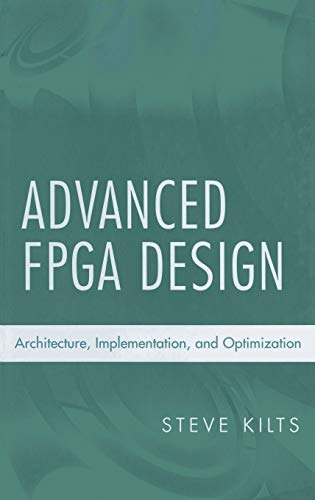
Advanced FPGA Design: Architecture, Implementation, and Optimization (IEEE Press)
This book provides the advanced issues of FPGA design as the underlying theme of the work. In practice, an engineer typically needs to be mentored for several years before these principles are appropriately utilized. The topics that will be discussed in this book are essential to designing FPGA's beyond moderate complexity. The goal of the book is to present practical design techniques that are otherwise only available through mentorship and real-world experience.

Introduction to Logic Synthesis Using Verilog HDL (Synthesis Lectures on Digital Circuits and Systems, 6) (Volume 0)
Introduction to Logic Synthesis Using Verilog HDL explains how to write accurate Verilog descriptions of digital systems that can be synthesized into digital system netlists with desirable characteristics. The book contains numerous Verilog examples that begin with simple combinational networks and progress to synchronous sequential logic systems. Common pitfalls in the development of synthesizable Verilog HDL are also discussed along with methods for avoiding them. The target audience is...

Logic Synthesis and Verification Algorithms
This book blends mathematical foundations and algorithmic developments with circuit design issues. Each new technique is presented in the context of its application to design. Through the study of optimal two-level and multilevel combinational circuit design, the reader is introduced to basic concepts, such as Boolean algebras, local search, and algebraic factorization. Similarly, through the study of optimal sequential circuit design, the reader is introduced to graph algorithms, finite...

Digital Design
While most popular digital design books present a perspective rooted in the 1970s and 1980s, Digital System Design takes the subject into the 21st century. It quickly moves through the low-levels of design, making a clear distinction between design and gate-level minimization. The book also emphasizes how one of the key uses of digital design today is to build high-performance alternatives to software in addition to glue logic. And it swiftly progresses to register-transfer-level (RTL)...

The Art of Verification with SystemVerilog Assertions
The Art of Verification with SystemVerilog Assertions (SVA) covers all aspects of SVA with numerous, detailed examples. The book demonstrates how SVA can be harnessed to implement effective, assertion-based verification.
It teaches the SVA language by explaining its usage in the context of practical verification issues. SVA syntax and features are explained in simple and easy-to-understand language. The usage of each construct is illustrated with both simple examples and examples drawn from...

SystemVerilog for Design Second Edition: A Guide to Using SystemVerilog for Hardware Design and Modeling
In its updated second edition, this book has been extensively revised on a chapter by chapter basis. The book accurately reflects the syntax and semantic changes to the SystemVerilog language standard, making it an essential reference for systems professionals who need the latest version information. In addition, the second edition features a new chapter explaining the SystemVerilog "packages", a new appendix that summarizes the synthesis guidelines presented throughout the book, and all of...

Writing Testbenches using SystemVerilog
Verification is too often approached in an ad hoc fashion. Visually inspecting simulation results is no longer feasible and the directed test-case methodology is reaching its limit. Moore's Law demands a productivity revolution in functional verification methodology.
Writing Testbenches Using SystemVerilog offers a clear blueprint of a verification process that aims for first-time success using the SystemVerilog language. From simulators to source management tools, from specification to...
Embedded Core Design with FPGAs
This is a complete toolkit for designing embedded cores and utilizing those cores in an embedded system. A landmark guide in digital system design, "Embedded Core Design with FPGAs" equips today's computer engineers with everything they need to design embedded cores and apply those cores in a state-of-the-art embedded system. This practical resource brings together logic design, computer architecture, Verilog, FPGAs, Hardware/Software design, and SoCs, explaining how engineers can draw on...

RTL Hardware Design Using VHDL: Coding for Efficiency, Portability, and Scalability (IEEE Press)
The skills and guidance needed to master RTL hardware design This book teaches readers how to systematically design efficient, portable, and scalable Register Transfer Level (RTL) digital circuits using the VHDL hardware description language and synthesis software. Focusing on the module-level design, which is composed of functional units, routing circuit, and storage, the book illustrates the relationship between the VHDL constructs and the underlying hardware components, and shows how to...