






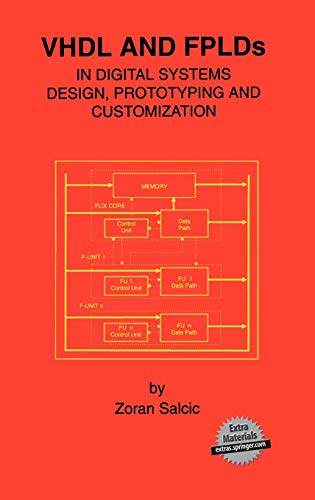



VHDL and FPLDs in Digital Systems Design, Prototyping and Customization
This book represents an attempt to treat three aspects of digital systems, design, prototyping and customization, in an integrated manner using two major technologies: VHSIC Hardware Description Language (VHDL) as a modeling and specification tool, and Field-Programmable Logic Devices (FPLDs) as an implementation technology. They together make a very powerful combination for complex digital systems rapid design and prototyping as the important steps towards manufacturing, or, in the case of feasible quantities, they also provide fast system manufacturing. Combining these two technologies makes possible implementation of very complex digital systems at the desk. VHDL has become a standard tool to capture features of digital systems in a form of behavioral, dataflow or structural models providing a high degree of flexibility. When augmented by a good simulator, VHDL enables extensive verification of features of the system under design, reducing uncertainties at the latter phases of design process. As such, it becomes an unavoidable modeling tool to model digital systems at various levels of abstraction.

Why Read This Book
You should read this book if you want a hands-on, VHDL-centered route from behavioral models to working programmable-logic prototypes: it ties VHDL modeling styles to practical implementation on FPLDs/CPLDs and shows common design and prototyping workflows. Although some device-specific examples reflect 1990s hardware, the book's guidance on synthesisable VHDL, design partitioning and prototyping remains a useful foundation.
Who Will Benefit
Students and engineers who know basic digital logic and want a practical bridge from VHDL descriptions to rapid prototyping on programmable logic devices or small FPGAs/CPLDs.
Level: Intermediate — Prerequisites: Basic digital logic (boolean algebra, combinational and sequential circuits) and familiarity with circuit-level concepts; no prior VHDL expertise required but helpful.
Key Takeaways
- Model digital systems in VHDL at behavioral, dataflow and structural abstraction levels.
- Translate VHDL descriptions into synthesisable code that maps to FPLD/CPLD resources.
- Evaluate trade-offs between logic, routing and timing when targeting programmable-logic devices.
- Prototype and iterate designs on FPLDs/CPLDs using vendor tool flows and testbenches.
- Design common digital building blocks and finite-state machines with attention to implementability.
- Apply basic timing-awareness and resource-optimization techniques for small-scale programmable logic.
Topics Covered
- Introduction: VHDL and Programmable Logic — scope and motivations
- VHDL Basics: language constructs, types and simulation model
- Modeling Styles: behavioral, dataflow and structural descriptions
- Combinational and Sequential Design in VHDL
- Finite State Machines and Control Structures
- Data-path Design and Modularization
- Synthesisable VHDL: constructs, restrictions and practice
- FPLD/CPLD Architectures and Implementation Technologies
- Mapping VHDL to FPLDs: partitioning and resource considerations
- Prototyping Workflows: tool flow, simulation and device programming
- Timing, Testing and Debugging on Programmable Logic
- Case Studies and Example Designs
- Appendices: VHDL reference and synthesis notes
Languages, Platforms & Tools
How It Compares
Covers similar ground to Peter Ashenden's The Designer's Guide to VHDL in terms of language fundamentals, but Salcic is more focused on FPLD/CPLD implementation and prototyping rather than exhaustive language semantics.