




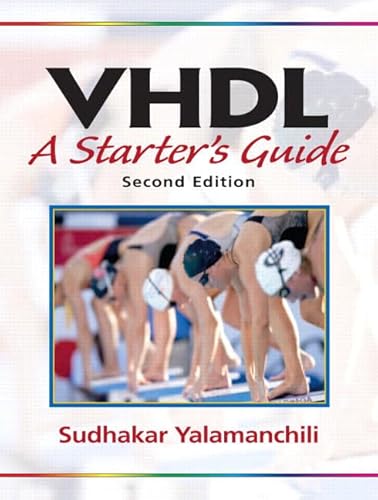
VHDL: A Starter's Guide (2nd Edition)
This handy reference gives readers a thorough grounding in the basic concepts and language of VHDL, and encourages them to apply what they have learned using realistic examples. Concepts are followed by examples and tutorials. Adds appendices to support material: Includes a tutorial for a popular VHDL simulator; a handy reference to common VHDL packages; and a detailed template for a VHDL model illustrating the relative ordering of program constructs. Emphasizes development of readers’ intuition and structured thinking about VHDL models without spending excessive time on advanced language features. Provides simulation and laboratory exercises that enable readers to quickly come up to speed in building useful, non-trivial models of digital systems. Provides tutorial descriptions and presentation of programming mechanics unique to CAD tools and environments. Includes examples, extensive use of timing diagrams, event lists and many tutorials for independent student study. Provides sample problems, many of which include worked solutions. Includes viewgraph masters and the VHDL source for all text examples. A useful reference for computer professionals who need to brush up on their VHDL knowledge.
Why Read This Book
You should read this book if you want a concise, practical introduction to VHDL that builds intuition through worked examples and lab-style exercises. It gets you writing and simulating real models quickly, includes a simulator tutorial and useful templates, and emphasizes synthesis-friendly coding rather than exhaustive language minutiae.
Who Will Benefit
Students and practicing engineers who know digital logic but are new to VHDL and need a hands-on, example-driven route to writing synthesizable HDL for FPGAs.
Level: Beginner — Prerequisites: Basic digital logic (combinational and sequential circuits) and familiarity with binary/boolean arithmetic; basic programming experience (helpful but not required).
Key Takeaways
- Understand VHDL syntax, data types, and the difference between concurrent and sequential constructs.
- Model and simulate combinational and sequential hardware, including registers, counters and FSMs.
- Write effective testbenches and use a VHDL simulator to verify designs and debug models.
- Structure designs using entities, architectures, packages and use generics and configurations.
- Apply synthesis-friendly coding styles and map VHDL constructs to FPGA implementation patterns.
- Use provided templates and example-driven patterns to jump-start medium-scale VHDL projects.
Topics Covered
- Introduction to VHDL and design methodology
- Basic language elements: identifiers, data types, operators
- Concurrent statements and modeling combinational logic
- Sequential statements and process-based modeling
- Signals, variables, and timing/simulation semantics
- Subprograms, procedures and functions
- Packages, libraries and design hierarchy
- Finite state machines and control logic
- Testbenches, stimulus generation and verification workflow
- Synthesis guidelines and mapping to FPGAs
- Lab exercises and simulator tutorial (ModelSim-like walkthrough)
- Appendices: common VHDL packages, coding templates and reference
Languages, Platforms & Tools
How It Compares
More tutorial- and example-focused than Peter J. Ashenden's The Designer's Guide to VHDL (which is a deeper language reference); closer in spirit to short, practical introductions like 'VHDL by Example' but with a clearer lab/simulator workflow.