






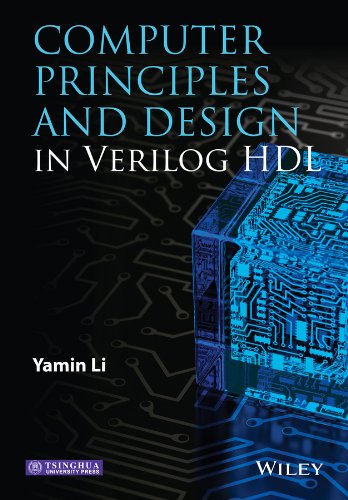



Computer Principles and Design in Verilog HDL
Uses Verilog HDL to illustrate computer architecture and microprocessor design, allowing readers to readily simulate and adjust the operation of each design, and thus build industrially relevant skills
• Introduces the computer principles, computer design, and how to use Verilog HDL (Hardware Description Language) to implement the design
• Provides the skills for designing processor/arithmetic/cpu chips, including the unique application of Verilog HDL material for CPU (central processing unit) implementation
• Despite the many books on Verilog and computer architecture and microprocessor design, few, if any, use Verilog as a key tool in helping a student to understand these design techniques
• A companion website includes color figures, Verilog HDL codes, extra test benches not found in the book, and PDFs of the figures and simulation waveforms for instructors

Why Read This Book
You will get a hands-on, HDL-centered walkthrough of processor and computer design that lets you simulate and modify each block in Verilog, so you can move from theory to a working CPU implementation. The book's example code and stepwise building of datapaths and control make it easy to apply concepts on FPGA toolchains and labs.
Who Will Benefit
Hardware engineers, advanced students, or FPGA developers who want to learn how to design CPUs, datapaths, and arithmetic units in Verilog and to prototype them on FPGAs.
Level: Intermediate — Prerequisites: Basic digital logic (combinational and sequential circuits), familiarity with Verilog or another HDL, and introductory computer architecture concepts (instruction, datapath, memory).
Key Takeaways
- Implement combinational and sequential building blocks in Verilog and create testbenches for simulation.
- Design and integrate arithmetic units (ALUs) and shifters suitable for processor datapaths.
- Construct single-cycle and multicycle CPU datapaths and derive the corresponding control logic in Verilog.
- Apply basic pipelining techniques and understand hazard types and simple mitigation strategies.
- Simulate, synthesize, and prepare HDL designs for FPGA prototyping with practical code examples.
- Analyze tradeoffs between microarchitectural choices (complexity, performance, area) when designing processors.
Topics Covered
- Introduction: Computer Principles and Verilog HDL
- Verilog Language Basics and Simulation
- Combinational Logic Design and Implementation
- Sequential Logic, Registers, and Finite State Machines
- Arithmetic Circuits and ALU Design
- Datapath Components and Interconnects
- Control Unit Design: Hardwired and Microprogrammed Approaches
- Single-Cycle and Multi-Cycle Processor Implementations
- Pipelining Concepts, Hazards, and Forwarding
- Memory Systems: RAM, ROM, and Basic Cache Concepts
- I/O, Interrupts, and Simple Peripheral Interfaces
- Verification, Testbenches, and Synthesis for FPGA
- Project: Building and Simulating a Complete CPU
- Appendices: Verilog Reference and Simulation Commands
Languages, Platforms & Tools
How It Compares
Similar in intent to Harris & Harris's Digital Design and Computer Architecture (which also uses Verilog) but focuses more narrowly on using Verilog to explain and implement processor building blocks rather than broader digital-system pedagogy.