









FPGARelated.com
Books

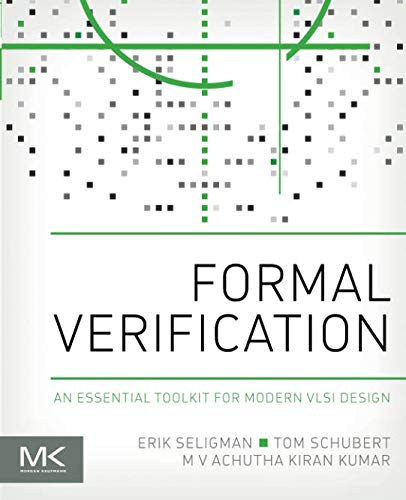
Formal Verification: An Essential Toolkit for Modern VLSI Design

Seligman MS, Erik, Schubert, Tom, Kumar M.Tech, 2015

Formal Verification: An Essential Toolkit for Modern VLSI Design presents practical approaches for design and validation, with hands-on advice to help working engineers integrate these techniques into their work. Formal Verification (FV) enables a designer to directly analyze and mathematically explore the quality or other aspects of a Register Transfer Level (RTL) design without using simulations. This can reduce time spent validating designs and more quickly reach a final design for manufacturing. Building on a basic knowledge of SystemVerilog, this book demystifies FV and presents the practical applications that are bringing it into mainstream design and validation processes at Intel and other companies. After reading this book, readers will be prepared to introduce FV in their organization and effectively deploy FV techniques to increase design and validation productivity.

  • Learn formal verification algorithms to gain full coverage without exhaustive simulation
  • Understand formal verification tools and how they differ from simulation tools
  • Create instant test benches to gain insight into how models work and find initial bugs
  • Learn from Intel insiders sharing their hard-won knowledge and solutions to complex design problems



Why Read This Book

You will learn how to demystify and practically apply formal verification to real-world RTL projects, with hands-on strategies and examples drawn from industry practice. The book shows how to write effective properties, scale formal engines, and fold formal checks into existing ASIC/FPGA design and verification flows to find bugs simulation misses and reduce validation time.

Who Will Benefit

Design and verification engineers (RTL/SystemVerilog) who want to adopt formal methods to improve bug finding, speed verification, and integrate formal checks into ASIC or FPGA workflows.

Level: Intermediate — Prerequisites: Basic SystemVerilog and RTL design knowledge, familiarity with digital logic and standard simulation-based verification flows; exposure to assertions (SVA/PSL) is helpful but not strictly required.

Get This Book

Key Takeaways

  • Write precise formal properties using SystemVerilog Assertions (and PSL) to capture intended RTL behavior
  • Apply model checking and equivalence checking techniques to prove properties and compare RTL to netlist/RTL variants
  • Integrate commercial formal engines and workflows into existing simulation and regression environments
  • Diagnose, interpret, and debug counterexamples and use abstraction/assumptions to scale proofs
  • Optimize RTL and verification models for formal analysis using bounding, abstraction, and helper logic
  • Demonstrate the practical ROI of formal methods and build a plan to introduce them into a team or project

Topics Covered

  1. Preface and motivation: Why formal verification now?
  2. Fundamentals of formal methods and model checking
  3. Property languages: SVA and PSL — writing meaningful assertions
  4. Modeling RTL for formal analysis: good and bad practices
  5. Formal engines and workflows: BMC, symbolic model checking, and SMT-based solving
  6. Equivalence checking and formal equivalence flows
  7. Scaling formal: abstraction, bounds, helper assertions, and decomposition
  8. Debugging counterexamples and using proofs to guide design fixes
  9. Integrating formal into simulation, coverage, and CI regression
  10. Industrial case studies and practical recipes from modern VLSI projects
  11. Metrics, ROI, team adoption, and process recommendations
  12. Advanced topics and future directions (compositional proofs, hybrid flows)
  13. Appendices: tool pointers, example properties, and reference material

Languages, Platforms & Tools

SystemVerilogVerilogVHDLSVAPSLSMT-LIB (for discussion of solvers)Generic RTL (ASIC/FPGA)Xilinx FPGA flowsIntel/Altera FPGA flowsHLS-generated RTL (high-level synthesis)Cadence JasperGold (and Jasper family concepts)Synopsys VC Formal / Formality conceptsOneSpin (Mentor/Siemens) formal toolsMentor Questa FormalSMT solvers (Z3, Yices) and BMC enginesEquivalence checking tools and RTL formal engines

How It Compares

More practical and industry-focused than the theory-heavy Principles of Model Checking (Baier & Katoen); complementary to SystemVerilog verification books that emphasize simulation rather than exhaustive formal proofs.

Related Books