









FPGARelated.com
Books

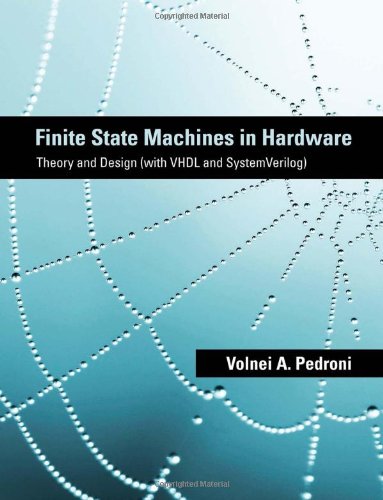
Finite State Machines in Hardware: Theory and Design (with VHDL and SystemVerilog)

Pedroni, Volnei A. 2013

Modern, complex digital systems invariably include hardware-implemented finite state machines. The correct design of such parts is crucial for attaining proper system performance. This book offers detailed, comprehensive coverage of the theory and design for any category of hardware-implemented finite state machines. It describes crucial design problems that lead to incorrect or far from optimal implementation and provides examples of finite state machines developed in both VHDL and SystemVerilog (the successor of Verilog) hardware description languages.

Important features include: extensive review of design practices for sequential digital circuits; a new division of all state machines into three hardware-based categories, encompassing all possible situations, with numerous practical examples provided in all three categories; the presentation of complete designs, with detailed VHDL and SystemVerilog codes, comments, and simulation results, all tested in FPGA devices; and exercise examples, all of which can be synthesized, simulated, and physically implemented in FPGA boards. Additional material is available on the book's Website.

Designing a state machine in hardware is more complex than designing it in software. Although interest in hardware for finite state machines has grown dramatically in recent years, there is no comprehensive treatment of the subject. This book offers the most detailed coverage of finite state machines available. It will be essential for industrial designers of digital systems and for students of electrical engineering and computer science.



Why Read This Book

You should read this book if you design control logic or complex sequential blocks in hardware and want a rigorous, practical treatment of finite state machines from theory through synthesizable HDL. It gives concrete VHDL and SystemVerilog examples, shows common pitfalls, and explains state encoding, minimization and synthesis trade-offs you’ll face on FPGAs and ASIC flows.

Who Will Benefit

FPGA/ASIC engineers and HDL designers with some digital-design background who need to design, optimize, and verify reliable hardware state machines.

Level: Intermediate — Prerequisites: Basic digital logic (combinational and sequential circuits), familiarity with HDL concepts and at least one HDL (VHDL or Verilog/SystemVerilog).

Get This Book

Key Takeaways

  • Apply formal FSM models (Mealy, Moore) to real hardware problems and choose the right model for your design
  • Perform state minimization and state-assignment to reduce area and improve timing for FPGA and ASIC targets
  • Select and implement state-encoding strategies (binary, one-hot, gray, optimized) and understand their trade-offs
  • Write synthesizable VHDL and SystemVerilog FSM implementations following robust coding styles and testbench practices
  • Identify and eliminate hazards, race conditions, and timing issues that commonly break sequential designs
  • Structure, pipeline, and decompose complex control logic for better performance and easier verification

Topics Covered

  1. Introduction to Finite State Machines and Motivation
  2. Review of Sequential Circuit Fundamentals
  3. FSM Models: Mealy and Moore
  4. State Minimization and Equivalence
  5. State Encoding and Assignment Techniques
  6. Implementation Styles: One-Hot, Binary, Gray, and Custom Encodings
  7. Hazards, Races, and Timing Considerations in Hardware FSMs
  8. Decomposition, Pipelining and Performance Optimization
  9. HDL Coding Guidelines for VHDL and SystemVerilog
  10. Synthesis Implications and FPGA/ASIC Mapping
  11. Verification: Testbenches, Simulation and Formal Checks
  12. Design Examples and Case Studies

Languages, Platforms & Tools

VHDLSystemVerilogFPGA (general)ASIC (general)Simulators (ModelSim/Questa or equivalent)Synthesis tools (Xilinx Vivado, Intel Quartus or equivalent)

How It Compares

More focused on FSM theory-to-hardware mapping than general textbooks like Mano or Harris & Harris; complements HDL-focused references by drilling into encoding, hazards and synthesizable VHDL/SystemVerilog examples.

Related Books