









VHDL : Programming By Example
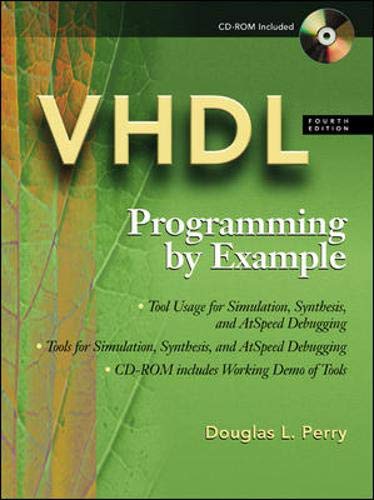
THE HANDS-DOWN FAVORITE USER’S GUIDE TO VHDLCOMPLETELY UPDATED TO REFLECT THE VERY LATEST DESIGN METHODS
CD-ROM WITH WORKING CODE EXAMPLES, VERIFICATION TOOLS AND MORE
No matter what your current level of expertise, nothing will have you writing and verifying concise, efficient VHDL descriptions of hardware designs as fast – or as painlessly – as this classic tutorial from master teacher Doug Perry. Beginners will find it an invaluable learning tool and experienced pros will keep it on their desk as a trusted reference.
Perry teaches VHDL through a series of hundreds of practical, detailed examples, gradually increasing in complexity until you’re capable of designing a fully functional CPU. The new Fourth Edition has been completely updated with all of the VDHL codes used in the examples changed to reflect today’s faster and more efficient design methods. You’ll also find:
* A CD-ROM containing working code of all of the VDHL examples, with their matching designs along with VITAL verification tools and a working copy of ModelSIM
* All the tools you need for simulation and synthesis
* A listing of the IEEE 1164 STD-LOGIC package used throughout the book
* Useful tables and figures
* Instructions for reading the Bachus-Naur format (BNF) descriptions found in the VHDL Language Reference Manual
There truly is no faster or smarter way to master VHDL than Doug Perry’s “learn by example” approach. It works!
Why Read This Book
You should read this book if you want a fast, hands-on route to writing readable, synthesizable VHDL through many worked examples and full designs. It walks you from basic constructs to complete designs (including a CPU example) and gives practical testbench and synthesis advice you can apply immediately.
Who Will Benefit
Beginners and early-intermediate digital designers or FPGA engineers who need a practical, example-driven introduction to VHDL coding, testbenches, and basic synthesis workflows.
Level: Beginner — Prerequisites: Basic digital-logic concepts (gates, flip-flops, FSMs) and familiarity with procedural programming (variables, control flow).
Key Takeaways
- Describe combinational and sequential hardware in VHDL using concurrent statements and processes.
- Model and implement finite-state machines and datapaths with clear, synthesizable VHDL patterns.
- Write structured testbenches to simulate and verify your designs before synthesis.
- Use VHDL-93 language constructs (generics, packages, records, generate) in practical designs.
- Partition designs into modules and packages so they scale to larger systems (examples include ALU and CPU designs).
- Apply basic synthesis and FPGA implementation guidelines so code maps cleanly to tools.
Topics Covered
- Introduction to VHDL and simulation
- VHDL language basics: types, objects, and operators
- Concurrent statements and signal assignment
- Sequential statements, processes, and variables
- Combinational and sequential circuit examples
- Modeling finite-state machines and control logic
- Design hierarchy, components, and configuration
- Packages, subprograms, and generics
- Testbenches, stimulus, and verification techniques
- Synthesis considerations and mapping to hardware
- Larger examples: ALU, datapath, and CPU walkthrough
- Advanced topics: attributes, file I/O, and simulation utilities
- Appendices: language reference and coding style tips
Languages, Platforms & Tools
How It Compares
More example-driven and tutorial-oriented than Peter Ashenden's The Designer's Guide to VHDL (which is more formal and exhaustive); less board-oriented and FPGA-lab focused than Pong P. Chu's FPGA Prototyping by VHDL Examples, which ties examples to specific FPGA boards and flows.