






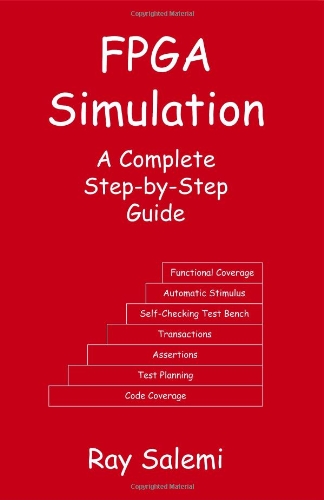



FPGA Simulation: A Complete Step-by-Step Guide
FPGA Simulation: A Complete Step-by-Step Guide shows FPGA design engineers how to avoid long lab debug sessions by simulating with SystemVerilog. The book helps engineers to have never simulated their designs before by bringing them through seven steps that can be added incrementally to a design flow. Engineers start with code coverage as the first step. Succeeding steps introduce test planning, assertions, and SystemVerilog simuation techniques. By the end of the process engineers who have never simulated before will know how to create complete self-checking test benches that generate their own stimulus, and demonstrate complete functional coverage. This book is a must for engineers who are facing DO-254 certification requirements on their next FPGA project.

Why Read This Book
You will learn a pragmatic, step-by-step approach to bringing simulation into an FPGA design flow so you avoid long hardware debug cycles. The book shows how to build self-checking testbenches, use assertions and coverage, and produce verification artifacts useful for DO-254-style certification.
Who Will Benefit
FPGA design engineers and verification engineers who write HDL and need to adopt simulation-driven verification or satisfy certification-quality verification documentation.
Level: Intermediate — Prerequisites: Basic digital logic and HDL coding familiarity (Verilog/SystemVerilog or VHDL) and exposure to FPGA build flows; no prior formal verification experience required.
Key Takeaways
- Create modular, self-checking SystemVerilog testbenches that generate their own stimulus
- Apply code and functional coverage metrics to measure verification completeness
- Use SystemVerilog assertions to catch and localize design intent violations
- Develop a practical test plan and incremental verification process that fits FPGA projects
- Prepare verification evidence and artifacts useful for DO-254 or high-assurance reviews
Topics Covered
- Introduction: Why Simulate and Overview of the Seven-Step Process
- Simulation Basics: Tools, Waveforms, and Simulation Flow
- Step 1 — Code Coverage: Measuring What You Run
- Step 2 — Test Planning: Mapping Requirements to Tests
- Step 3 — Designing Self-Checking Testbenches
- Step 4 — Assertions and SystemVerilog Assertions (SVA)
- Step 5 — Functional Coverage and Coverage-Driven Verification
- Step 6 — Constrained Random and Stimulus Generation
- Step 7 — Integrating Simulation Into FPGA Development and DO-254 Considerations
- Testbench Architectures and Reuse Strategies
- Practical Examples and Complete Testbench Walkthroughs
- Appendices: Tool Tips, Scripts, and Quick Reference
Languages, Platforms & Tools
How It Compares
More hands-on and FPGA/DO-254–oriented than 'SystemVerilog for Verification' (Spear), and more step-by-step/practical for FPGA engineers than Janick Bergeron's 'Writing Testbenches.'