






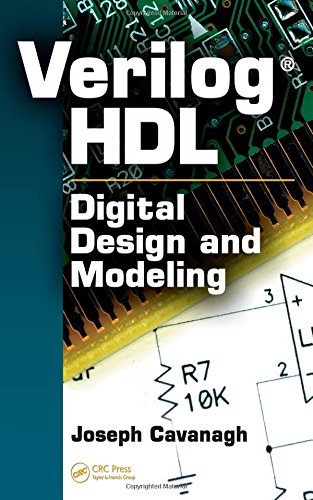



Verilog HDL: Digital Design and Modeling
Emphasizing the detailed design of various Verilog projects, Verilog HDL: Digital Design and Modeling offers students a firm foundation on the subject matter. The textbook presents the complete Verilog language by describing different modeling constructs supported by Verilog and by providing numerous design examples and problems in each chapter. Examples include counters of different moduli, half adders, full adders, a carry lookahead adder, array multipliers, different types of Moore and Mealy machines, and much more. The text also contains information on synchronous and asynchronous sequential machines, including pulse-mode asynchronous sequential machines.
In addition, it provides descriptions of the design module, the test bench module, the outputs obtained from the simulator, and the waveforms obtained from the simulator illustrating the complete functional operation of the design. Where applicable, a detailed review of the topic's theory is presented together with logic design principles, including state diagrams, Karnaugh maps, equations, and the logic diagram.
Verilog HDL: Digital Design and Modeling is a comprehensive, self-contained, and inclusive textbook that carries all designs through to completion, preparing students to thoroughly understand this popular hardware description language.
Why Read This Book
You will get a hands‑on, example‑driven introduction to Verilog that shows how to model combinational and sequential logic, write test benches, and build common arithmetic and FSM blocks. The book emphasizes practical design patterns and numerous worked problems so you can move from simulation to synthesizable RTL with confidence.
Who Will Benefit
Undergraduate students and engineers new to HDL-based digital design who need a practical guide to Verilog modeling, FSM design, and testbench creation.
Level: Intermediate — Prerequisites: Basic digital logic (gates, flip‑flops, combinational/sequential concepts) and some programming familiarity (algorithms and basic syntax).
Key Takeaways
- Describe and use Verilog's modeling styles: behavioral, dataflow, and structural.
- Implement combinational logic (adders, multipliers, encoders) and synchronous sequential circuits in Verilog.
- Design and encode Moore and Mealy finite state machines and convert specifications to RTL.
- Write effective test benches and interpret simulator output to validate designs.
- Apply synthesis-minded coding practices (blocking vs non‑blocking assignments, clocked processes) to produce synthesizable RTL.
Topics Covered
- Introduction to Verilog and digital design methodology
- Verilog language basics: modules, ports, data types, and operators
- Modeling styles: gate, dataflow, and behavioral descriptions
- Combinational circuits: design examples and coding patterns
- Sequential circuits: flip‑flops, registers, and timing
- Finite State Machines: Moore and Mealy machines
- Synchronous and asynchronous sequential machines (including pulse‑mode)
- Arithmetic units: adders, multipliers, and implementation techniques
- Test benches, simulation, and waveform analysis
- Synthesis considerations and coding for hardware
- Design examples and lab/project exercises
- Appendices: Verilog references and simulation output interpretation
Languages, Platforms & Tools
How It Compares
Less of a terse language reference than Palnitkar's Verilog HDL and more example/project oriented than many reference texts; compared to Brown & Vranesic it is more Verilog‑centric and example driven rather than covering multiple HDLs.