






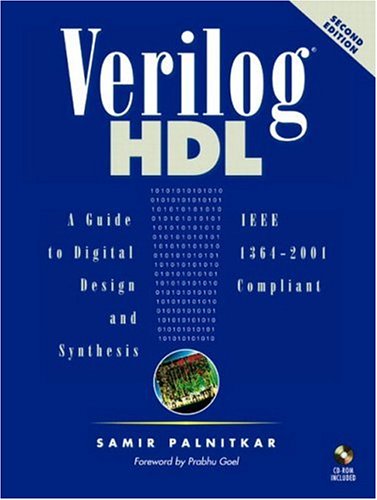



Verilog Hdl: A Guide to Digital Design and Synthesis
Verilog HDL is a language for digital design, just as C is a language for programming. This complete Verilog HDL reference progresses from the basic Verilog concepts to the most advanced concepts in digital design. Palnitkar covers the gamut of Verilog HDL fundamentals, such as gate, RTL, and behavioral modeling, all the way to advanced concepts, such as timing simulation, switch level modeling, PLI, and logic synthesis. Verilog HDL is a hardware description language (with a user community of more than 50,000 active designers) used to design and document electronic systems. This completely updated reference progresses from basic to advanced concepts in digital design, including timing simulation, switch level modeling, PLI, and logic synthesis.
Why Read This Book
You should read this book if you need a clear, compact introduction and day-to-day reference for writing and reading Verilog RTL. It takes you from basic language constructs to practical topics like testbenches, timing simulation, and synthesis guidelines so you can produce synthesizable code and debug designs effectively.
Who Will Benefit
Novice-to-practicing digital designers and FPGA/ASIC engineers who need a hands-on Verilog language guide and a concise reference for RTL coding and simulation.
Level: Beginner — Prerequisites: Basic digital logic (combinational and sequential circuits) and binary/Boolean arithmetic; familiarity with programming concepts (e.g., variables, control flow) is helpful but not required.
Key Takeaways
- Write correct Verilog modules using gate-, dataflow-, and behavioral-level styles
- Construct testbenches and use simulation constructs to validate RTL
- Apply timing and delay modeling for functional and timing simulation
- Prepare synthesizable Verilog and follow practical synthesis coding guidelines
- Use tasks, functions and the PLI to structure testbenches and extend simulation
- Understand switch-level modelling and its relationship to gate-level and RTL views
Topics Covered
- Introduction to Verilog and Digital Design
- Lexical Conventions, Data Types and Operators
- Modules, Ports, Net and Variable Declarations
- Gate-level Modeling
- Dataflow Modeling
- Behavioral Modeling (always blocks, procedural statements)
- Timing, Delays and Timing Simulation
- Testbenches and Simulation Techniques
- Tasks, Functions, and System Tasks
- Switch-Level Modeling
- Logic Synthesis and Coding Guidelines
- Programming Language Interface (PLI) and Advanced Interfaces
- Practical Examples and Design Patterns
- Appendices: Verilog-2001 additions and reference material
Languages, Platforms & Tools
How It Compares
More approachable and concise than the formal specification-style treatment in Thomas & Moorby's classic, and less FPGA-lab-focused than Pong Chu's 'FPGA Prototyping with Verilog Examples' which emphasizes hands-on projects.