






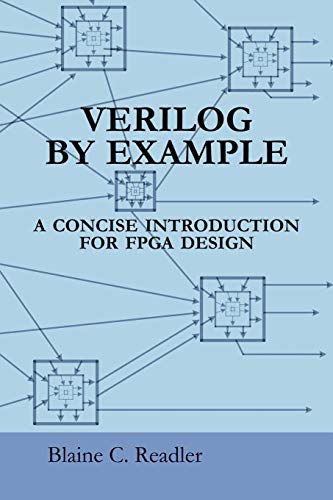



Verilog by Example: A Concise Introduction for FPGA Design
A practical primer for the student and practicing engineer already familiar with the basics of digital design, the reference develops a working grasp of the verilog hardware description language step-by-step using easy-to-understand examples. Starting with a simple but workable design sample, increasingly more complex fundamentals of the language are introduced until all major features of verilog are brought to light. Included in the coverage are state machines, modular design, FPGA-based memories, clock management, specialized I/O, and an introduction to techniques of simulation. The goal is to prepare the reader to design real-world FPGA solutions. All the sample code used in the book is available online. What Strunk and White did for the English language with "The Elements of Style," VERILOG BY EXAMPLE does for FPGA design.
Why Read This Book
You should read this book if you want a compact, example-first introduction to writing synthesizable Verilog for real FPGA designs. It walks you from small, working examples to more realistic modules (state machines, block RAMs, clock/reset handling) so you can quickly start coding and simulating designs you can actually synthesize.
Who Will Benefit
An undergraduate or practicing engineer who knows basic digital logic and wants a practical, hands-on route to become productive writing synthesizable Verilog for FPGAs.
Level: Intermediate — Prerequisites: Basic digital logic (gates, Boolean algebra), familiarity with registers and finite-state machines; some exposure to FPGAs is helpful but not strictly required.
Key Takeaways
- Write synthesizable Verilog modules using both behavioral and structural styles.
- Design and implement finite-state machines (Moore and Mealy) in Verilog.
- Infer and instantiate FPGA block RAMs and implement simple memory interfaces.
- Create and run simple testbenches and basic simulation flows to verify RTL.
- Manage clocking and reset strategies appropriate for FPGA implementations.
- Integrate specialized I/O constructs and understand common synthesis considerations.
Topics Covered
- Introduction and getting started with Verilog
- Combinational logic and operators
- Structural vs. behavioral descriptions
- Registers and sequential logic
- Finite-state machines: design and implementation
- Module hierarchy and parameterization
- Memories and FPGA block RAM usage
- Clocking, resets, and timing considerations
- Specialized I/O and synthesis pragmas
- Testbenches and simulation techniques
- Synthesis guidelines and FPGA implementation notes
- Appendices: coding style, language reference, example code
Languages, Platforms & Tools
How It Compares
Shorter and more example-driven than Samir Palnitkar's 'Verilog HDL' and less comprehensive but more practical for quick FPGA work than Pong P. Chu's 'FPGA Prototyping by Verilog Examples', which contains larger board-oriented projects.