






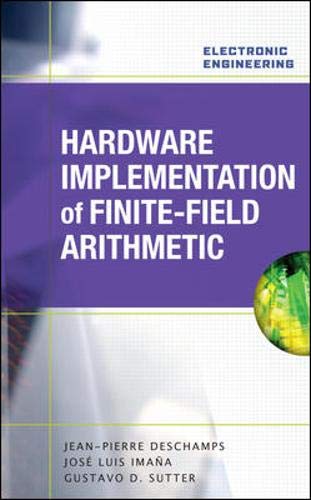



Hardware Implementation of Finite-Field Arithmetic (Electronic Engineering)
Implement Finite-Field Arithmetic in Specific Hardware (FPGA and ASIC)
Master cutting-edge electronic circuit synthesis and design with help from this detailed guide. Hardware Implementation of Finite-Field Arithmetic describes algorithms and circuits for executing finite-field operations, including addition, subtraction, multiplication, squaring, exponentiation, and division.
This comprehensive resource begins with an overview of mathematics, covering algebra, number theory, finite fields, and cryptography. The book then presents algorithms which can be executed and verified with actual input data. Logic schemes and VHDL models are described in such a way that the corresponding circuits can be easily simulated and synthesized. The book concludes with a real-world example of a finite-field application--elliptic-curve cryptography. This is an essential guide for hardware engineers involved in the development of embedded systems.
Get detailed coverage of:
- Modulo m reduction
- Modulo m addition, subtraction, multiplication, and exponentiation
- Operations over GF(p) and GF(pm)
- Operations over the commutative ring Zp[x]/f(x)
- Operations over the binary field GF(2m) using normal, polynomial, dual, and triangular

Why Read This Book
You will learn how to translate finite-field mathematics into efficient, synthesizable hardware: the book walks you from algebraic foundations through concrete VHDL models and FPGA/ASIC implementation techniques. It pairs rigorous algorithmic treatment with practical design guidance so you can simulate, synthesize, and optimize GF arithmetic blocks for cryptography and coding applications.
Who Will Benefit
Hardware engineers, FPGA designers, and graduate students with some digital-design and algebra background who need to implement high-performance finite-field arithmetic for cryptography, error-correcting codes, or DSP accelerators.
Level: Advanced — Prerequisites: Solid understanding of digital logic and synchronous design, familiarity with VHDL (or another HDL), and undergraduate-level algebra/number theory (finite fields).
Key Takeaways
- Implement GF addition, multiplication, squaring, inversion, and exponentiation as synthesizable VHDL modules.
- Map finite-field algorithms to hardware architectures (combinational, sequential, pipelined) and choose trade-offs between area, latency, and throughput.
- Optimize implementations using polynomial and normal bases, composite-field techniques, and basis conversion strategies.
- Simulate and synthesize designs targeting FPGAs and ASIC flows, and evaluate resource use and timing on Xilinx and Altera devices.
- Apply finite-field hardware blocks to real applications such as ECC, AES-related operations, and Reed–Solomon/BCH decoding.
Topics Covered
- 1. Introduction and Motivation: Hardware for Finite Fields
- 2. Mathematical Foundations: Algebra, Number Theory, and Finite Fields
- 3. Representations: Polynomial, Normal, and Composite Bases
- 4. Basic Operations: Addition, Subtraction, and Field Reduction
- 5. Multiplication and Squaring Algorithms
- 6. Inversion and Exponentiation Techniques
- 7. Hardware Architectures: Combinational, Sequential, and Pipelined Designs
- 8. VHDL Modeling and Testbenches for Finite-Field Operators
- 9. Synthesis and Implementation on FPGA and ASIC Flows
- 10. Optimization Strategies: Area, Power, and Timing
- 11. Applications: Cryptography and Error-Correcting Codes
- 12. Case Studies and Measured Implementations
- Appendices: Mathematical Tables, HDL Templates, and Verification Data
Languages, Platforms & Tools
How It Compares
Compared with Lidl & Niederreiter's Finite Fields (theory-heavy reference), Deschamps focuses on hardware realization and VHDL examples; compared to cryptographic engineering texts (e.g., Paar & Pelzl), it goes deeper into GF arithmetic circuits rather than system-level crypto integration.