









FPGARelated.com
Books

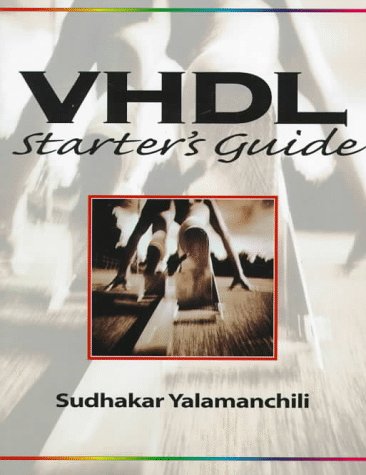
VHDL Starter's Guide

Sudhakar Yalamanchili 1997

To be used as a primer or companion text for Digital Logic Design, Computer Architecture and VLSI Design courses given at the sophomore and junior levels.Designed as an inexpensive companion text in courses that use VHDL, this book provides students with a thorough grounding in the basic concepts and language of VHDL, and allows them to apply what they've learned using realistic examples. Concepts are followed by examples and tutorials. For schools wanting to introduce VHDL into their undergraduate computer engineering sequence courses, this inexpensive supplement provides the basics.



Why Read This Book

You will get a compact, example-driven introduction to VHDL that walks you from language syntax to modeling combinational and sequential circuits with practical tutorials. The book is designed as a classroom companion, so you will benefit from clear examples and step-by-step exercises that map theory into runnable VHDL descriptions.

Who Will Benefit

Undergraduate students, instructors, and engineers new to hardware description languages who need a course-style, practical introduction to VHDL for FPGA/RTL work.

Level: Beginner — Prerequisites: Basic digital logic (truth tables, gates, combinational/sequential circuits) and general programming familiarity (variables, control flow).

Get This Book

Key Takeaways

  • Describe VHDL language elements, data types, and syntax for common RTL constructs.
  • Model combinational and sequential logic using concurrent and sequential VHDL statements.
  • Construct and run testbenches to simulate and verify VHDL designs.
  • Apply structural and behavioral modeling and use generics, packages, and component instantiation.
  • Translate simple digital circuits (adders, counters, FSMs) into synthesizeable VHDL suitable for FPGA flows.

Topics Covered

  1. Introduction to VHDL and Design Methodology
  2. Basic Language Elements: Lexical Rules, Identifiers, Comments
  3. Data Types, Objects, and Operators
  4. Concurrent Statements and Structural Modeling
  5. Sequential Statements and Processes
  6. Modeling Combinational and Sequential Circuits
  7. Subprograms, Packages, and Libraries
  8. Testbenches and Simulation Techniques
  9. Finite State Machines and HDL Design Patterns
  10. Synthesis Concepts and Mapping to Hardware
  11. Examples and Tutorials: Adders, Counters, ALU, FSMs
  12. Practical Projects and Course Assignments
  13. Appendices: VHDL Reference and Style Notes

Languages, Platforms & Tools

VHDLFPGA (general)ASIC (conceptual)ModelSim (or other VHDL simulators)Xilinx ISE / Spartan-era FPGA tools (historical)Synthesis tools (e.g., Synplify — general guidance rather than tool-specific tutorials)

How It Compares

Covers similar introductory ground to Bhasker’s 'A VHDL Primer' but is more course/assignment-oriented and less exhaustive than Ashenden’s 'The Designer's Guide to VHDL' (which is the deeper, modern reference).

Related Books