






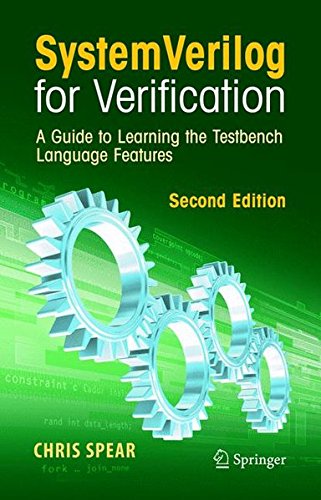



SystemVerilog for Verification: A Guide to Learning the Testbench Language Features
The updated second edition of this book provides practical information for hardware and software engineers using the SystemVerilog language to verify electronic designs. The author explains methodology concepts for constructing testbenches that are modular and reusable. The book includes extensive coverage of the SystemVerilog 3.1a constructs such as classes, program blocks, randomization, assertions, and functional coverage. This second edition contains a new chapter that covers programs and interfaces as well as chapters with updated information on directed testbench and OOP, layered, and random testbench for an ATM switch.

Why Read This Book
You will get a concise, example-driven tour of the SystemVerilog features used to build modern, reusable testbenches, with practical guidance on constrained randomization, assertions, and coverage. The book emphasizes real testbench patterns and a worked ATM-switch example so you can apply techniques to your verification flows quickly.
Who Will Benefit
Engineers and verification engineers who know Verilog and want a focused, practical reference to adopt SystemVerilog testbench features and build modular, coverage-driven verification environments.
Level: Intermediate — Prerequisites: Basic digital design and Verilog knowledge, and familiarity with simulator-based verification concepts (stimulus/response, testbenches, simulation).
Key Takeaways
- Use SystemVerilog classes and OOP techniques to structure reusable testbench components.
- Apply constrained-random stimulus generation and manage seeds to drive robust verification.
- Write and apply SystemVerilog assertions (SVA) to catch functional bugs early.
- Define and measure functional coverage to quantify verification completeness.
- Design modular, layered testbenches (directed, OOP, and randomized) and integrate scoreboards/checkers.
- Leverage program blocks and interfaces to improve testbench modularity and DUT connectivity.
Topics Covered
- Introduction and Overview of SystemVerilog Verification
- Basic Verification Constructs and Testbench Concepts
- Data Types, Operators and Enhanced Verilog Features for Testbenches
- Classes and Object-Oriented Testbench Design
- Program Blocks, Interfaces and Modular Connectivity
- Constrained Randomization and Randomization Techniques
- SystemVerilog Assertions (SVA) and Temporal Properties
- Functional Coverage and Coverage-driven Verification
- Layered, OOP and Directed Testbench Architectures
- Practical Case Study: ATM Switch Testbench
- Debugging, Simulation Best Practices and Common Pitfalls
- Appendices: Language Reference and Tooling Notes
Languages, Platforms & Tools
How It Compares
More verification-focused and example-driven than 'SystemVerilog for Design' (Sutherland et al.), and complementary to Bergeron's 'Writing Testbenches' which is broader on methodology but less centered on SystemVerilog language features.